
What is a microbiome?
Have you heard of yogurt or sauerkraut being good for your digestion? Or maybe you are a kimchi, kombucha person? You have probably seen their package labels saying “Contains live cultures” or even better, saying “Contains Lactobacillus” or “Contains Bifidobacteria”. These live cultures is what makes these products so good for you.
In our gut we have plenty of these bacteria too, in fact there are over 100 trillion of them there. Look at your thumb 👍 – there are more bacteria on it than the whole population of the UK. In terms of cells we are actually outnumbered, there are more bacteria cells in us than human cells. Anyway, I made the point clear – there are a lot of them. What makes it difficult is the fact that some of them are reaaaaally good for us, helping us digest food, making us happy by producing serotonin (the happiness hormone) and keeping our gut health in check while others are trying to kill those good guys and make us miserable (it’s life after all, eh).
When we don’t eat healthy, take medications like antibiotics or affect our internal ecosystem in any other way, these bad bugs can see the opportunity and outnumber the good. Whether there is a peaceful balance or a nuclear war in your gut can be checked using gut microbiome tests. These tests essentially analyse your poop samples. I know, sounds gross, but is one or two tests really much worse than picking a poop after your dog every day or changing a diaper? Anyhow, you can send a poop (stool) sample to a specialised laboratory where they analyse it. I will talk here about what options are available in the UK.
What to look for in a microbiome test
I have tried 8 different microbiome tests in the last couple of years and I am ready to rate them. But before that, here is my list of things that I look for in a microbiome test:
🦠 Microbe species tested – the more types of bacteria a tested the better, especially if it is your first test and you don’t know what is going on. If you have severe issues it might be worth looking for tests that check for parasites, H. pylori and C. difficile. Others, who have persistent thrush (like me) may benefit from tests looking at Candida Albicans and other Candida species. Most tests have a report sample on their website (if not, contact them and they might email you one). That sample should show all the species they test for.
- 👩🔬 Science-backed indicators of the “right” amount – it is good to have some benchmark. 7% Faecalibacterium prausnitzii – is it good, is it bad? It is useful to have some indicator and a research reference for it.
- 📈 Metabolic information – does the test offer anything else other the amount of bacteria in your gut? For example, some tests measure zonulin (an indicator of an inflammation) or butyrate levels. Others even test your blood sugar response.
- 📑 Clear instructions and a working kit – test instructions should be clear. Stool catching equipment should work. I have had experience before with stool catchers that don’t stick to the toilet seat. There should also be a return envelope in your test kit with the address of the lab it is going to.
- 🏃♂️ Speed – how long does it take to get results? In my experience it can be anything from 1.5 weeks to 5 weeks (from the day of the test).
- 💰 £££ – microbiome tests are very expensive so cost can be a deal breaker.
- 🥗 Post-test recommendations – some tests give you advice or guidance for what to do to improve your results. Not all of that advice is good though, so be warned.
Now moving on to the list… Bear in mind I haven’t tested all tests available in the UK, so there may be some that I have overlooked. All tests that I have tried have some benefits, so even though I have given a lower rating so some, that does not mean they are necessarily bad. It just means they could benefit from some improvement.
The ranking
#7 Neovos

Neovos is the lowest in my rankings but it is not bad if you look for a cheap test but this one is way too limited. If you are looking for the cheapest possible test then look no further. Neovos actually offer three different tests at different prices but I have tried only the Compositional Gut Test. I have put it last in my list primarily because it looks at very few bacteria species and does not count Candida species (yeast) which is my primary interest.
Where to get it: https://neovos.com/product/compositional-gut-test/
Cost: £80
Analysis time: around 2 weeks
Pros:
- Cheap
- Tests for E. coli and C. difficile
- Simple kit, easy to use
Cons:
- Very few species tested, does not test for Candida
- Not enough detail in the results
- Very generic diet advice (kind of like eat fruits and veg)
#6 Verisana

Verisana Candida Test is the best when it comes to checking for Candida overgrowth but their Comprehensive Tests are way too expensive. They offer several test kits on their website which differ in terms of what species and biomarkers they test for. I have only had experience with their Candida test and cannot recommend it enough. Unlike other tests out there, their Candida test analyses not only your stool sample but also your saliva sample. In my case the test did not show Candida in stool but showed a significant overgrowth in my saliva:

Where to get it: https://www.verisana.co.uk/product-category/gut-health-tests/
Cost: £80-£384 depending on the test
Analysis time: around 2 weeks but depends on the test
Pros:
- Many options for gut tests
- Detailed stool analysis
- Fast results (For Candida test only – I have not tested others)
Cons:
- Comprehensive analysis is expensive
- Not the best quality test kit
- I am not sure about the accuracy of the stool pH they measure
- No diet recommendations
#5 EasyDNA

This one is probably one of my personal favourites because I like to test my microbiome on a regular basis and the price for this test allows me to do so (at a stretch). This is a relatively cheap and detailed stool test that measures a lot of bacteria species in your gut. It measures Akkermansia Muciniphila which is a really important bacteria protecting our gut lining. Not many other tests do that. It does not measure Candida though.
Where to get it: https://easydna.co.uk/gut-health-microbiome-test/
Cost: £129 for the first test, any additional test £90
Analysis time: 4-5 weeks
Pros:
- Cheap
- Very detailed analysis
- Quick stool collection method
- Measures Akkermansia
Cons:
- Very long waiting time for the results
- A lot of additional bacteria species tested but no clarity whether they are good or bad
- Very generic recommendations (pretty much “eat more fruit and veg”)
- Test kit could benefit from some improvement
I was also missing a return envelope in my kit. I hope they have fixed that.
#4 GetTested Small

This is one of the cheapest tests. In fact, they offer a 10% discount if you order 3 tests or more. For this reason I have been using this test for a while now to track how changes in my diet affect me. There is another blog where I shared my results.
Where to get it: https://gettested.co.uk/product/small-gut-microbiome-test/
Cost: £99, 10% off if you order two or more tests.
Analysis time: 1.5-2 weeks
Pros:
- Cheap
- Checks for a variety of bacteria and fungi (including Candida Albicans)
- Fast results
Cons:
- Stool catcher does not stick (I use tape)
- Does not report specific strains of Bifidobacteria or Lactobacillus, number of strains is limited to specific species.
- Some sample tubes are missing the “necessary amount” label
#3 Healthpath
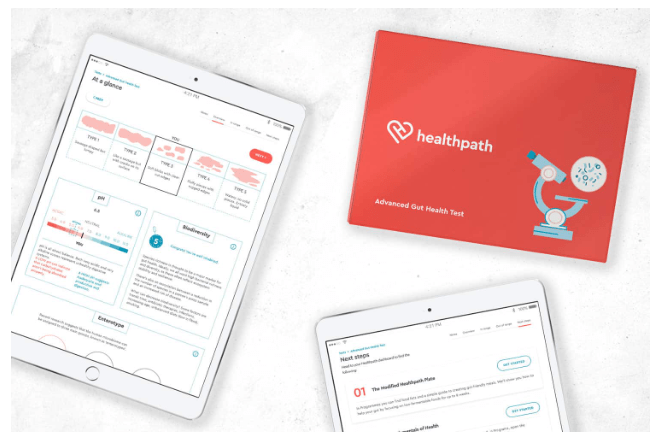
This was the first test that I have tried. At the time I tried it there were not many other tests available. It is also usually the first one that comes up when you search for a microbiome test on the internet. It is quite a comprehensive test that checks for a huge range of bacteria, parasites and fungi. But it comes at a price. The price is so high though that I do not think it is worth it compared to the ZOE test that is first in my ranking. They call themselves a UK’s leading gut test and compare themselves with other tests which I do not think is up-to-date. Their comparison may have been valid a couple of years ago but not anymore. They give some guidance for the diet which was quite nice and the recipes they provide are really tasty. But the supplements they recommended to me made my condition worse.
Where to get it: https://healthpath.com/products/tests/
Cost: £389
Analysis time: 2 weeks
Pros:
- Amazingly detailed analysis
- Clear guidance and a well-maintained website where your results can be viewed
- Post-test diet and supplement recommendations
Cons:
- Very expensive, no cheaper alternative option
- Some supplements are questionable and lack scientific basis
- Long waiting time for the results
#2 GetTested M/L/XL

GetTested offer more tests other than Gut Microbiome Small, they offer Medium, Large and X-Large tests. These tests look at additional bacteria and biomarkers compared to the small one.
Where to get it: https://gettested.co.uk/product-category/gut-health-tests/
Cost: £149-£279, 10% off if you order two or more tests
Analysis time: 1.5-2 weeks
Pros:
- Plenty of important species analysed e.g. Akkermansia
- More affordable than some other comprehensive tests
- Quick results
Cons:
- No post-processing such as that in ZOE, you get results and then you are on your own
- Not clear to me why they look at certain species and do not look at other
- Stool catcher does not stick to the toilet seat (I used tape)
#1 ZOE

I have written two detailed blogs about my ZOE journey: here and here.
ZOE is on top of my list because they are based on several years of research, they are transparent, there are smart people working behind it. They not only look at your microbiome but look at your body metabolism as a whole. They measure your glucose response to food and your blood fat response. They also offer a “retest” (included in the price) to see if your microbiome improves after diet recommendations.
Where to get it: https://zoe.com/
Price: £300 for a test plus £25-60 per month for a membership (depends on its duration, longer = cheaper). You can get 10% off with this referral.
Analysis time: 3-4 weeks (worth the wait though)
Pros:
- Amazingly comprehensive test, combines microbiome and metabolism analysis (blood sugar and fat response)
- Has an incredible scientific backing and is based on the results of thousands of people
- Very well presented, easy to follow and understand
- Transparent science – they publish research papers, make podcasts where they admit that it is always “work in progress”, inform the public via a blog and Youtube for free
Cons:
- The price bites, membership is very expensive too, but the price includes retesting!
- Generating the results takes some time (but they are worth the wait)
- Does not measure Candida Albicans
- I wish they had more focus on diseases like IBS, Ulcerative Colitis, Crohns…


 Health Experiment
Leave a comment