
How I tested my microbiome every week for two months
Introduction
Three years ago I have developed health issues due to the use of birth control pills (if only doctors would tell you about the risks…). It started first with rosacea on my skin and then developed further into other skin and digestive issues. I later found out that those issues were to do with a yeast called Candida Albicans overgrowing in my gut. I found it out through a comprehensive gut microbiome test which showed the overgrowth but also all of my symptoms were pointing out to that nasty fungus as well. I had a coated tongue, toenail fungus and tinnitus so bad that I found it hard to fall asleep. On top of that this year I found out I have high-risk human papilloma virus and low grade cervix cell abnormalities. Lucky, eh? I still have not fully resolved these issues (even though I’ve off birth control for years now) but I believe I am on the right path. In the past year I have learned so much about human microbiome via books, research papers and my personal experiments that I am bursting with knowledge and I decided to share my learnings with you. In this blog I will share my gut microbiome test experiment. I have tested my microbiome every week for eight weeks to see how different foods affect my microbiome. Don’t worry, there won’t be any photos of the “experimental procedures” (it probably would be the best way to start blogging).
Experiment overview
Okay, so let me layout the experiment for you:
- Every day of every week I would record every food that I have put in my mouth.
- I would also record any supplement I was taking. Some supplements I would only for a week and then stop (to see how they affect my microbiome results).
- I wouldn’t record the exact amounts of the food eaten because counting every gram would probably destroy my mental health on the way but I did record how many portions of each food I ate. For example, if I ate pasta for lunch and for dinner in one day then I would record it as “two portions”.
- I ordered 8 test kits from GetTested, unlike other microbiome tests I have tried (that deserves another blog post) GetTested offer much cheaper gut tests under 100£ per small test (in 2023) and that was important for me if I wanted to afford a test every week.
- I would then collect my poop (most exciting part for sure) using the test kit and send it back to the GetTested labs.
- GetTested would then return the results of my tests to me about 2 weeks after doing each test. I will go through each week’s results one by one and share my findings with you.
Food diary
To start with, here is a table where I recorded how many portions of each food I ate in the four days prior to the gut microbiome test. Why four days and not a week? I have realised through some experience with these tests that it is the last couple of days before the test that really shape my biome. I do however have daily records of my food consumption beyond those four days so if you are a researcher or a geek like me who wants to play around with “inputs” (foods) and “outputs” (biome results) then do not hesitate to drop me a message.
So, here is the table as promised
| Food | Week 1 | Week 2 | Week 3 | Week 4 | Week 5 | Week 6 | Week 7 |
| aubergine (often with tahini) | 4 | ||||||
| almonds | 4 | ||||||
| apple | 3 | ||||||
| artichoke | 1 | ||||||
| avocado | 2 | 4 | 6 | ||||
| barley | 4 | 3 | |||||
| basil | 3 | 1 | 4 | 2 | |||
| blueberries | 4 | 2 | 2 | 3 | 2 | ||
| brazil nuts | |||||||
| broccoli | 3 | ||||||
| Buckwheat | 3 | 2 | 5 | 3 | |||
| cashew | 6 | 4 | |||||
| cabbage | 4 | 3 | 3 | 4 | |||
| Carrot | 4 | 3 | |||||
| cauliflower | |||||||
| celery | |||||||
| chia | 2 | 1 | 1 | 3 | 2 | ||
| Chickpeas | 1 | 1 | 5 | ||||
| Cheese | 3 | 3 | |||||
| chocolate | 1 | 5 | 3 | 1 | |||
| coconut milk | 1 | ||||||
| yogurt (coconut) | 3 | ||||||
| coriander | |||||||
| courgette | 3 | 5 | 2 | 3 | 3 | ||
| cranberry | 2 | 2 | 3 | 2 | |||
| eggs | 3 | 3 | 4 | 2 | 6 | 3 | |
| garlic | |||||||
| grapefruit | |||||||
| green beans | |||||||
| Green peas | |||||||
| kale | 1 | 1 | 2 | ||||
| lemon | 3 | ||||||
| Lions mane | 1 | 2 | 1 | ||||
| Millet | |||||||
| mussles/shrimp | 1 | 1 | 1 | ||||
| Oats | 4 | ||||||
| olives | 6 | 7 | 7 | 3 | 4 | 7 | 3 |
| parsley | 4 | 1 | 2 | 3 | |||
| parsnip | |||||||
| pepper | 4 | 1 | 1 | ||||
| pine nut | 4 | 2 | |||||
| pumpkin seeds | 3 | 2 | 4 | 5 | 4 | 3 | 3 |
| pomegranate | 2 | 3 | 2 | 3 | 3 | 1 | |
| Quinoa | 3 | 2 | 5 | 1 | |||
| Raspberry | 2 | 3 | 1 | 3 | 2 | ||
| red onion | 4 | 3 | 4 | ||||
| rice | |||||||
| rocket | 2 | 2 | 5 | 7 | |||
| salmon/cod | 3 | 3 | 3 | 1 | 2 | 2 | |
| spinach | 2 | 2 | 2 | ||||
| Sweet potato | |||||||
| tofu | |||||||
| tempeh | |||||||
| tomato | 3 | 7 | 4 | 6 | 8 | 6 | 7 |
| walnuts | 6 | 5 | 2 | 6 | |||
| WW pasta | 1 | 2 | 4 | 3 | |||
| YP pasta | 2 | 5 | 2 | ||||
| yogurt (natural) | 3 | 5 | 5 | 4 | 3 | 3 | |
| green tea | |||||||
| flaxseed | 4 | 2 | 2 |
Week 1
Supplements:
- Oregano oil once a day
- Lactobacillus rhamnosus twice a day (10 billion CFU)
- Lactobacillus paracasei once a day (5 billion CFU)
- Bifidobacterium lactis BB-12 twice a day (25 billion CFU) with FOS (Optibac)
It is often recommended to stop any supplements before taking the biome tests, but in this particular test I didn’t. Bear this in mind.
Here are my results in the first week:
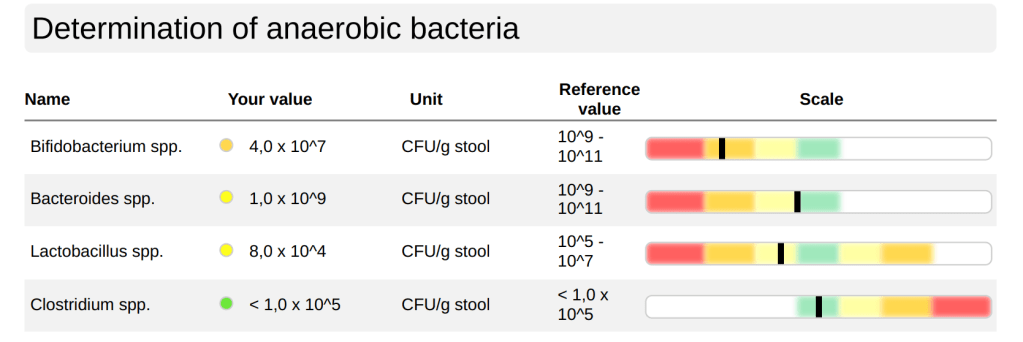
Looking a bit sad, aren’t they? Very low bifidobacteria despite still taking my probiotic supplements. I strongly suspect bifidobacteria here though are low due to oregano oil and not the food I ate. We will see in other weeks that my food consumption is similar but bifidobacteria are more abundant. This week resulted in quite a low lactobacillus result as well. Bacteroides are borderline low. Interestingly, my pH is also quite low this week, just 5.5…
Week 2
Supplements:
- Oregano oil once a day (only the first half of the week because it started causing constipation)
- Lactobacillus rhamnosus once a day (10 billion CFU)
- Bifidobacterium lactis BB-12 once a day (25 billion CFU) with FOS (Optibac)
This time I also didn’t stop taking probiotics before the test.
Results after week 2:
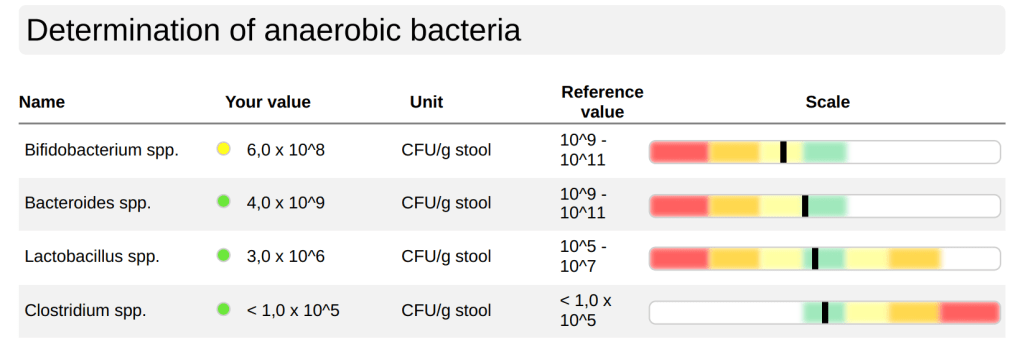
Interesting! My bacteria improved, but bifidobactera is still low. We can also see a very good result for lactobacillus. When I first saw this result I could not draw any conclusion. It is later with more tests I realise why… After doing more tests I later suspect it is white cabbage that is the superhero behind the lactobacilli hill.
Week 3
Supplements:
- Lactobacillus rhamnosus once a day (10 billion CFU)
- Bifidobacterium lactis BB-12 once a day (25 billion CFU) with FOS
- Galacto-oligosaccharides or GOS (around half a teaspoon a day)
This week gave me the best results:
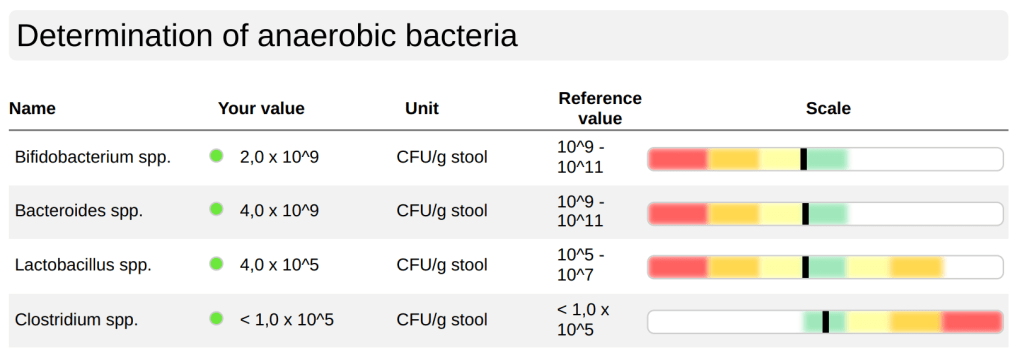
It is interesting that although the results show that everything is great, my symptoms stayed the same this week. My conclusion from it is that I cannot trust the symptoms alone… Interestingly, lactobacillus results dropped a bit. This week I did not eat any cabbage… I did eat kale and rocket though (cabbage relatives) which is possibly why it did not drop any lower.
Week 4
Supplements:
- Lactobacillus rhamnosus once a day (10 billion CFU)
- Lactobacillus paracasei once a day (5 billion CFU)
- Bifidobacterium lactis BB-12 once a day (25 billion CFU) with FOS
- GOS (one teaspoon a day)
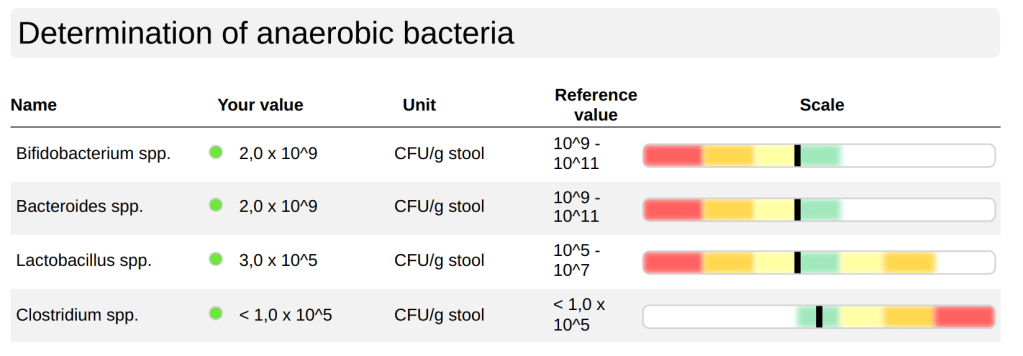
This week I decided to increase my GOS dose, I have also added an additional probiotic. But none of these have improved my results further, in fact they got worse if anything. My pH of this week’s test was also slightly high: 6.5.
Week 5
Supplements:
- Lactobacillus rhamnosus once a day (10 billion CFU)
- Lactobacillus paracasei once a day (5 billion CFU)
- Bifidobacterium lactis BB-12 once a day (25 billion CFU) with FOS
- GOS (one teaspoon a day)
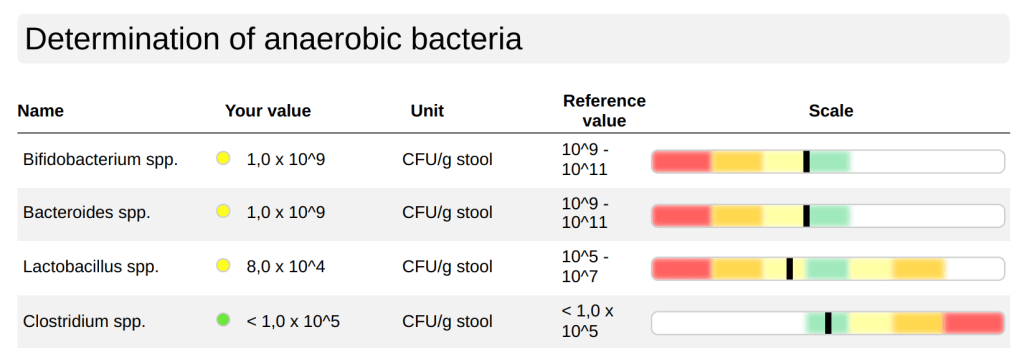
This week my results worsen further despite me taking the same supplements. I realise this week that the food I eat make a stronger impact on my microbiome than the probiotics or fibre supplements.
Week 6
Supplements:
- Lactobacillus rhamnosus once a day (10 billion CFU)
- Lactobacillus paracasei once a day (5 billion CFU)
- Bifidobacterium lactis BB-12 once a day (25 billion CFU) with FOS
- GOS (one teaspoon a day)
By the end of this week I have results from weeks 1-4 and I start to wonder whether it is cabbage that makes my lactobacilli go up… I therefore add cabbage to my diet at the very end of the week. These are the results from Monday after week 6 diet:
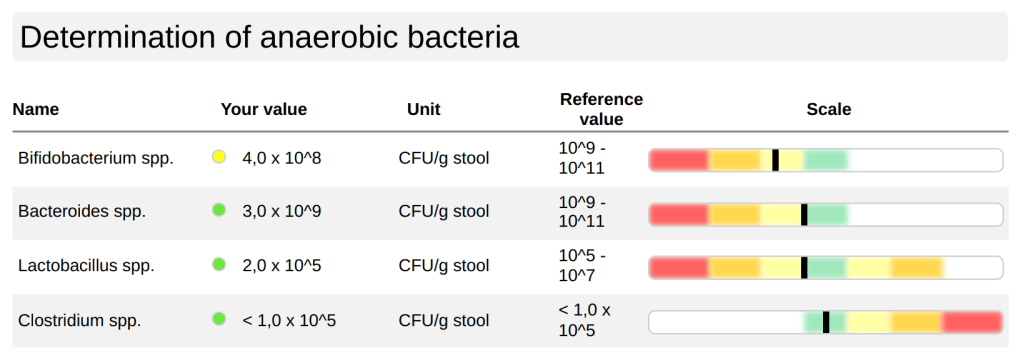
We can see that lactobacilli indeed increased. Could it be cabbage? I continue eating cabbage in week 7, so stay tuned for week 7 results (or scroll down if you’re too curious)… My bifidobacterium however dropped further. Looking at the previous tests and seeing the food records in my food table I believe that bifidobacterium is linked to the increased consumption of buckwheat and yellow pea pasta in weeks 3-4. The insight I got from reading research papers tells me that bifido has a preference for carbs (specifically grains). The carbs that I ate in this experiment are: buckwheat, chickpeas, yellow pea pasta, quinoa, wholewheat pasta and oats. In weeks 3 and 4 I ate quite a few portions of buckwheat. In week 5 I stopped eating buckwheat but switched to the yellow pea pasta. In this week, week 6, I ate a lot of quinoa and some wholeweat pasta and my bifido is lower than weeks before. So far it looks like bifido might be a fan of buckwheat and yellow peas. And it does not seem to have any particular feelings for oats (see week 7) or quinoa by the looks of it…
Week 7
Supplements:
- Lactobacillus rhamnosus once a day (10 billion CFU)
- Lactobacillus paracasei once a day (5 billion CFU)
- Bifidobacterium lactis BB-12 once a day (25 billion CFU) with FOS
- GOS (half a teaspoon a day)
- I try beta-glucan, but only take 3 beta-glucans in the beginning of this week
This week I stop taking any supplement except for GOS two days before the test. Here are the results:
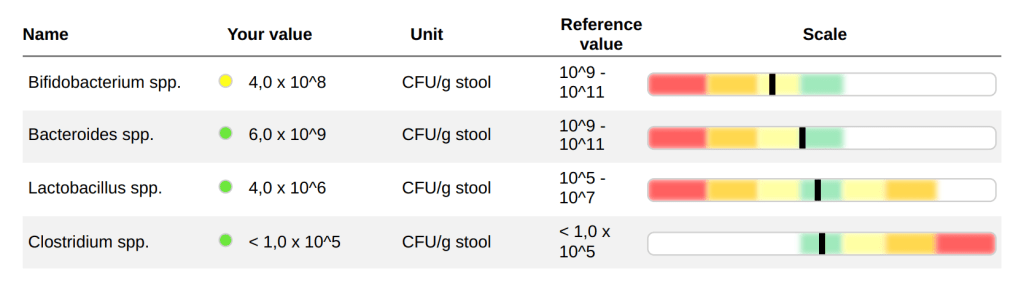
I was very excited to see the result of week 7. It seems that indeed cabbage plays a big role in my lactobacilli species. But this week I suspect that broccoli, the sister of cabbage, may have also boosted the lactobacilli result. This week I was eating only oats and wholewheat pasta and it seems my bifidobactrium was left a bit hungry. It didn’t change at all from the previous week. Interestingly, my bacteroides have increased as well. I find it hard to get a connection between bacteroides and specific foods. It seems that different species of bacteroides prefer different foods but generally I suspect that raspberries, apples and oats may have contributed to the increase in bacteroides.
Week 8
Supplements:
- Lactobacillus rhamnosus once or twice a day (10 billion CFU)
- Lactobacillus paracasei once a day (5 billion CFU)
- Bifidobacterium lactis BB-12 once a day (25 billion CFU) with FOS
- GOS (half a teaspoon a day)
- This week I decide to try ARMRA bovine colostrum and I regret it very much….
The results are here:
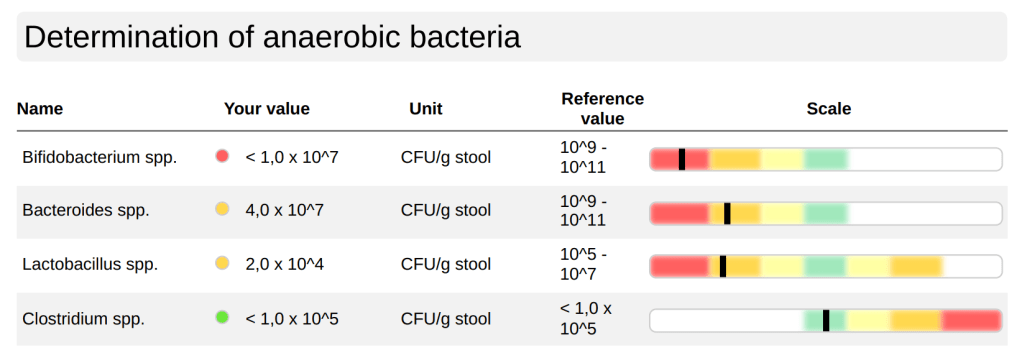
To say I was disappointed is to say nothing. I was angry, I was really upset with ARMRA. It is advertised as a miracle supplement that is supposed to heal your gut, allergies and solve all your problems. Too good to be true but I bought their advertising like a 5-year-old kid. As you can see all my results have worsened and on top of that I was feeling rubbish that week after trying colostrum. One night I even woke up in the middle of the night to go to the bathroom (very unusual for me, I never wake up at night). My advice is stay as far away from ARMRA bovine colostrum as you can.
I cannot even say anything about the dietary impact this week because colostrum has completely ruined the test results. This is why I haven’t even included the food records in the table for week 8.
I will continue testing my gut microbiome though and will give updates in the next blogs, so stay tuned! I hope this was helpful and if you would like to find out more about my experiments do not hesitate to contact me. If you are doing anything similar or just doing one or two gut tests let me know! I would be curious to find out about your diet before the test and your results. Together we could find what foods make the most positive impact.
See you next time!
With health in mind,
Health Experiment


 Health Experiment
Leave a reply to Kisha Cancel reply